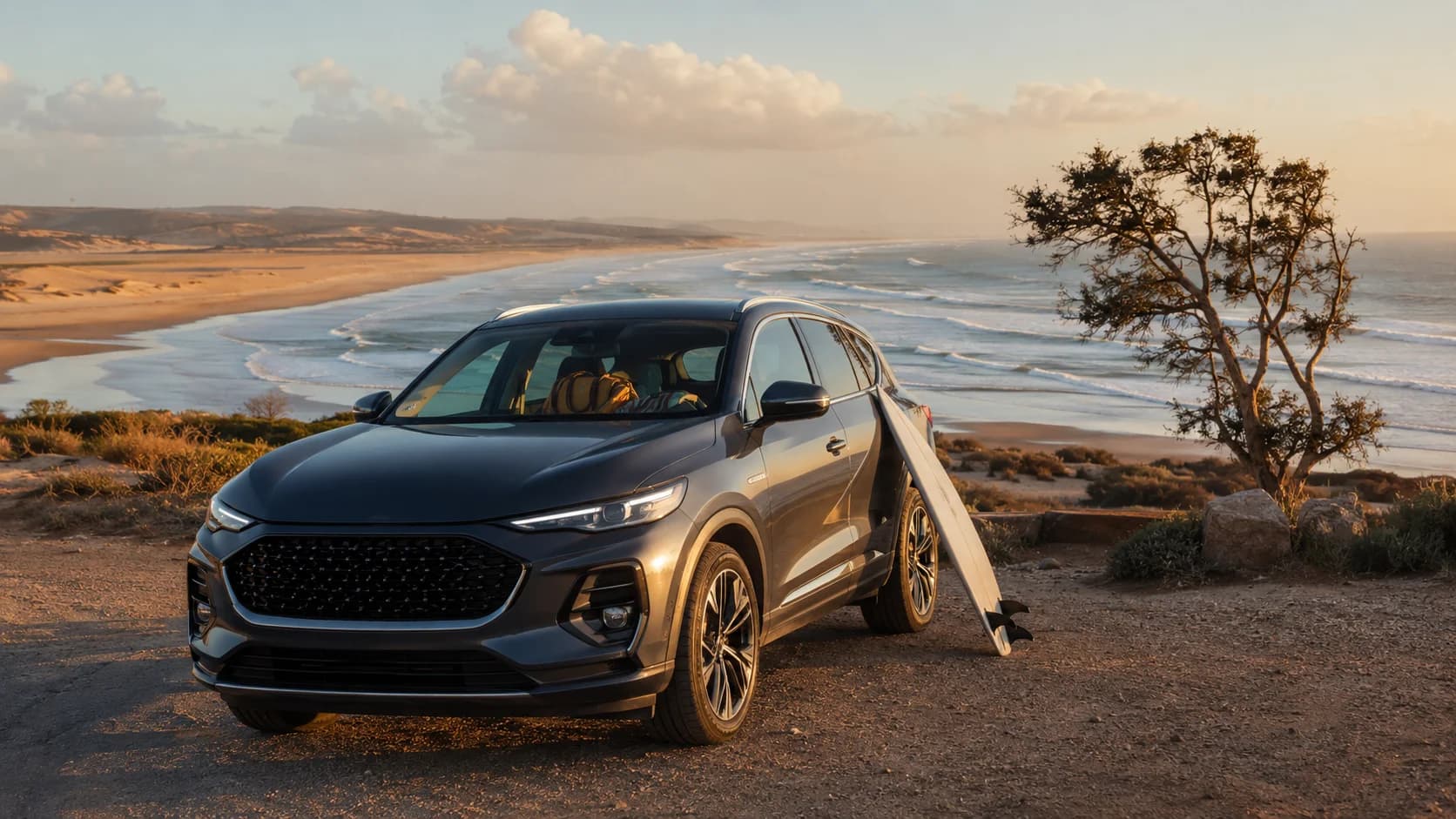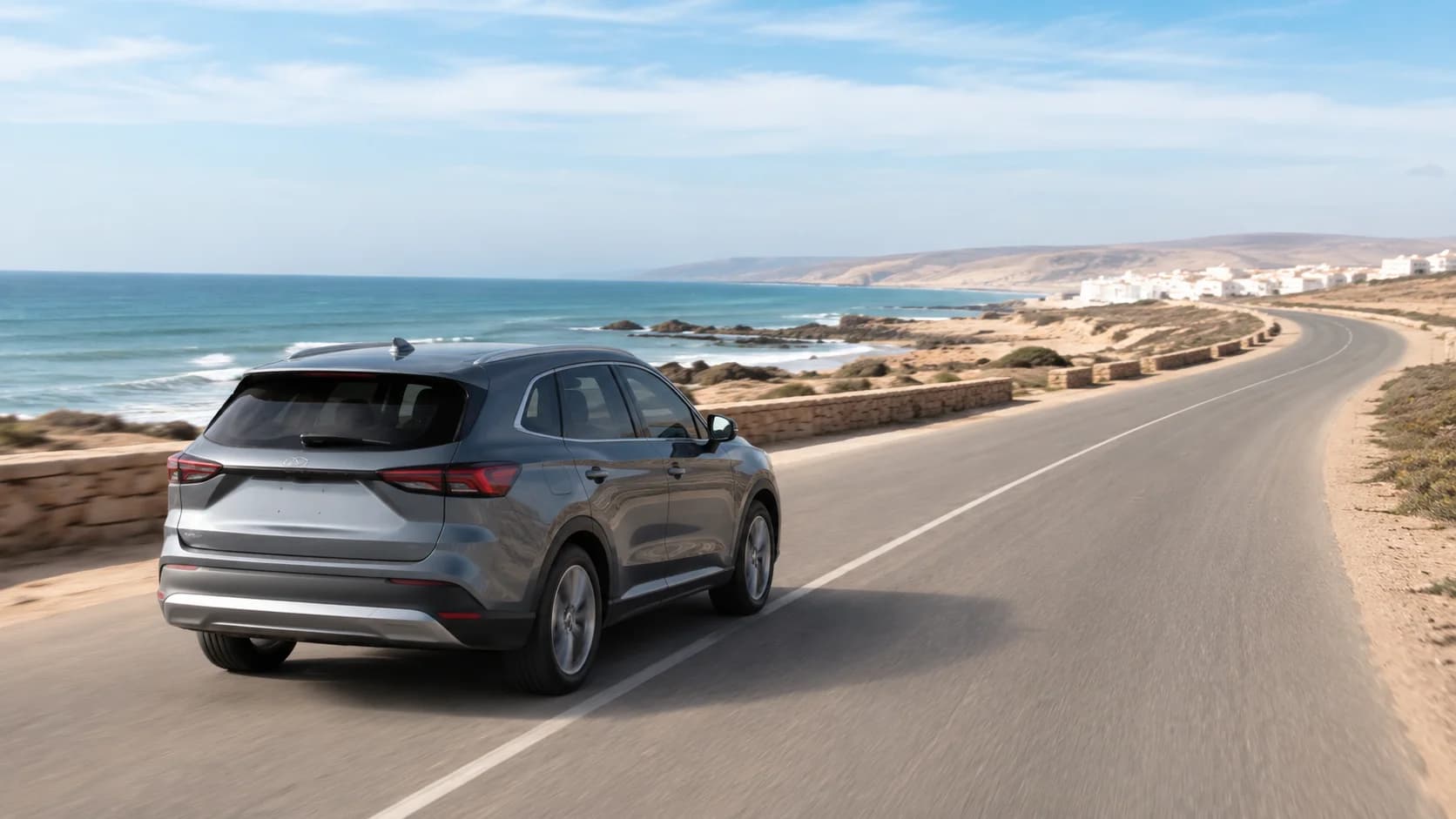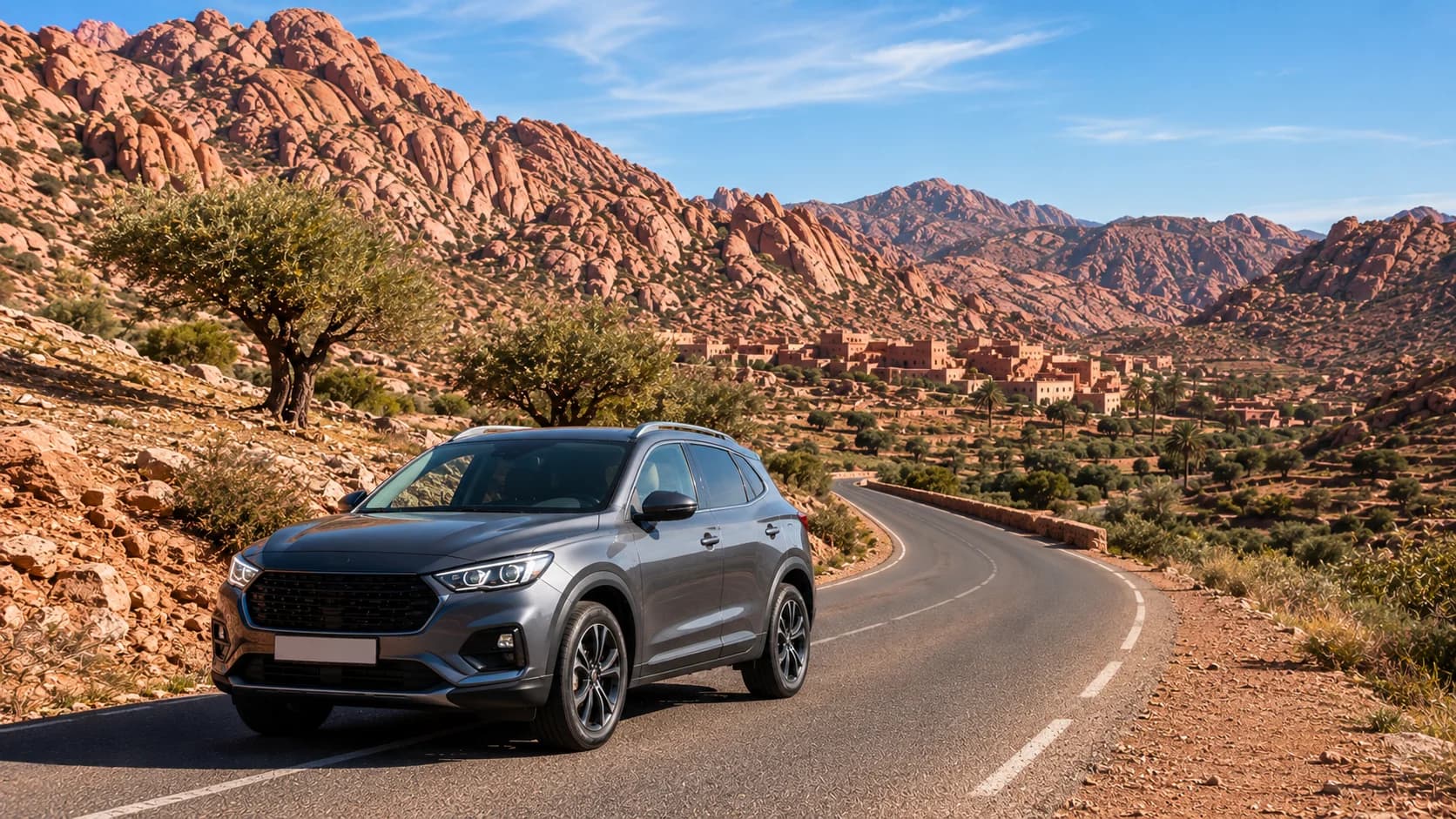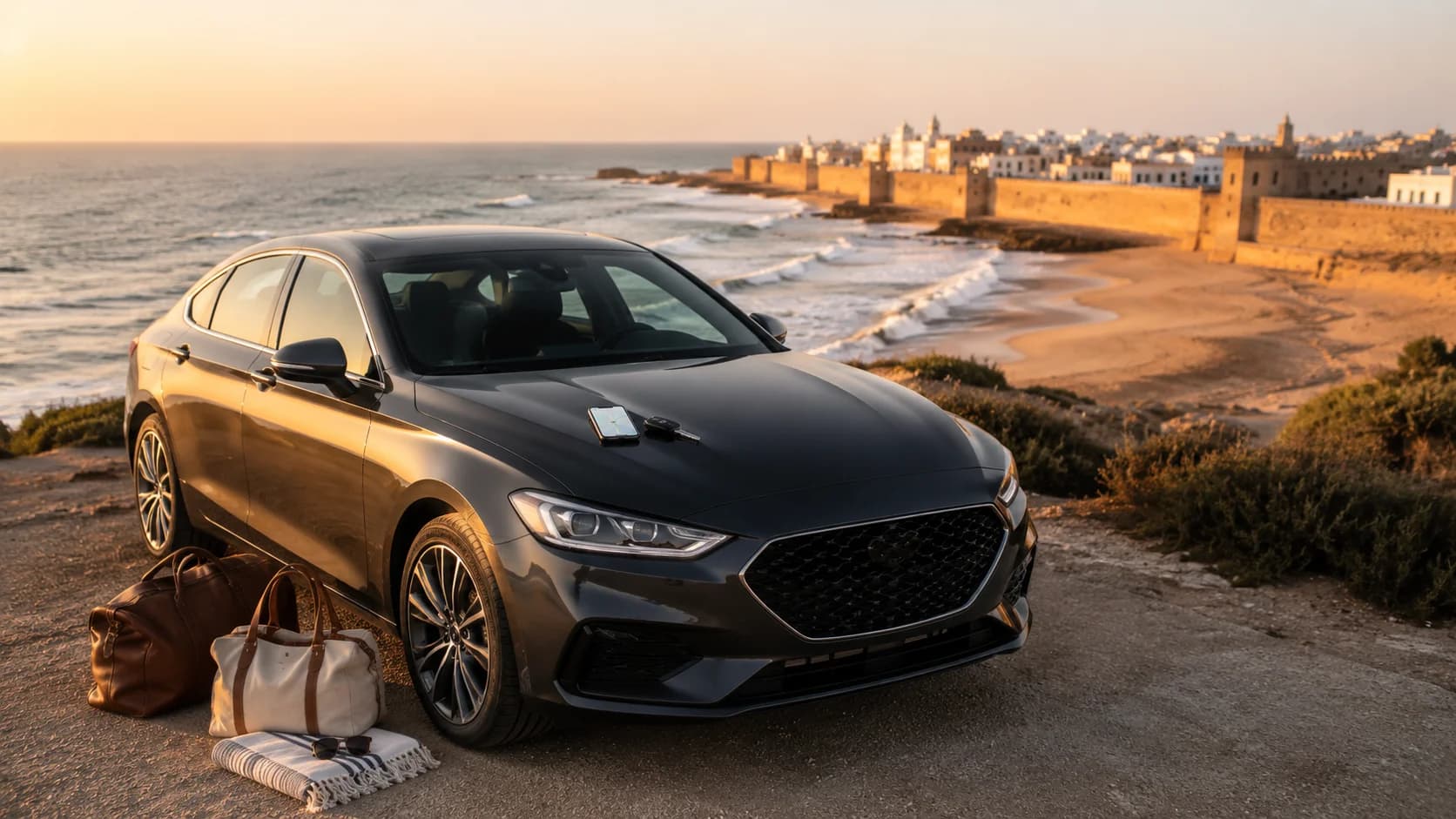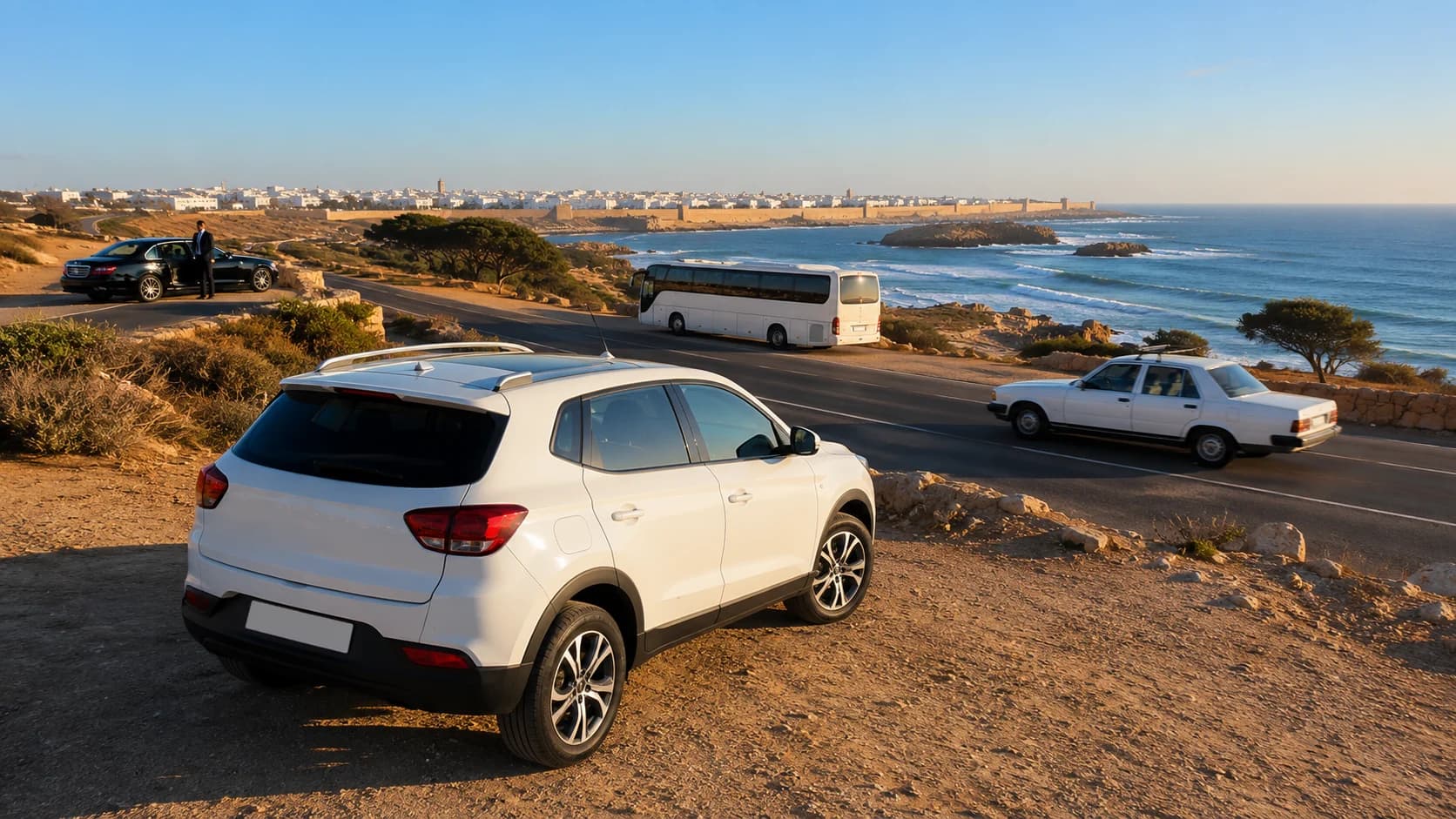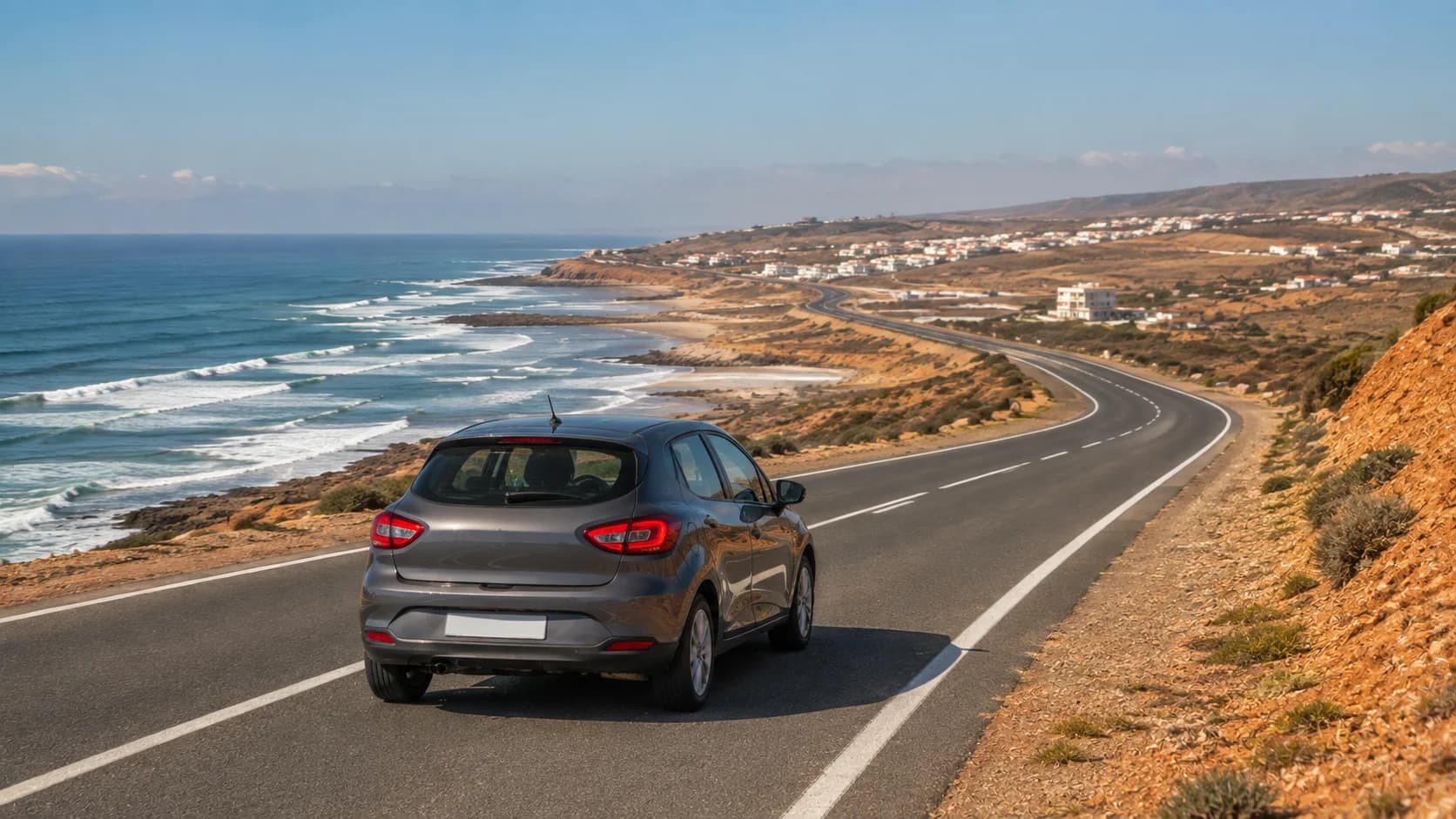









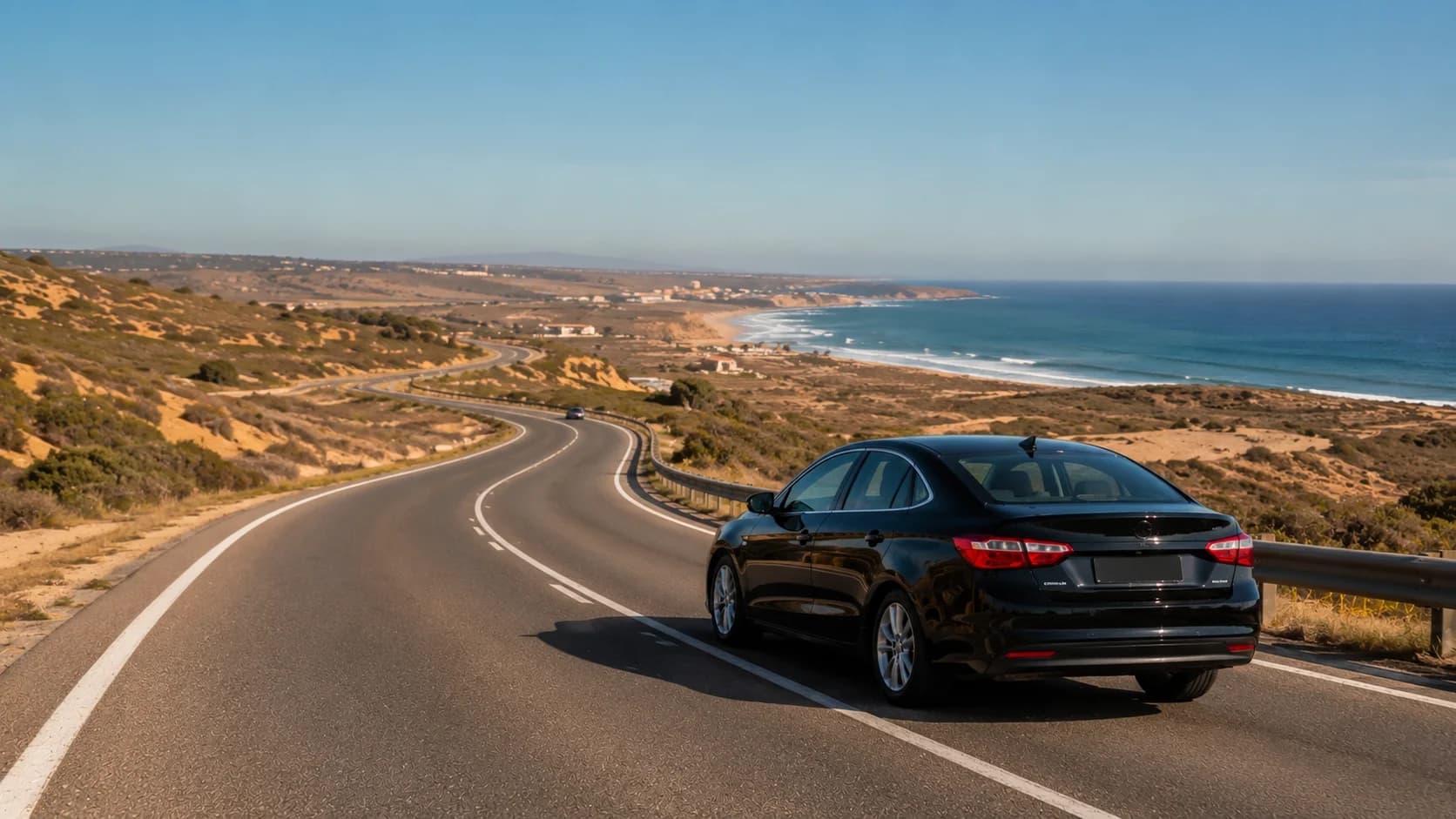
Driving Essaouira to Rabat by car is one of the most practical ways to connect Morocco’s Atlantic coast with the capital while turning a long transfer into part of the trip itself. The journey links Essaouira with Safi, the El Jadida corridor, Casablanca and finally Rabat, giving travelers several opportunities to stop along the way.
The road distance is approximately 435 km, with around 5 hours 10 minutes of pure driving time under favorable conditions. In practice, allowing six hours or more is more comfortable once fuel, food, traffic and rest breaks are included.
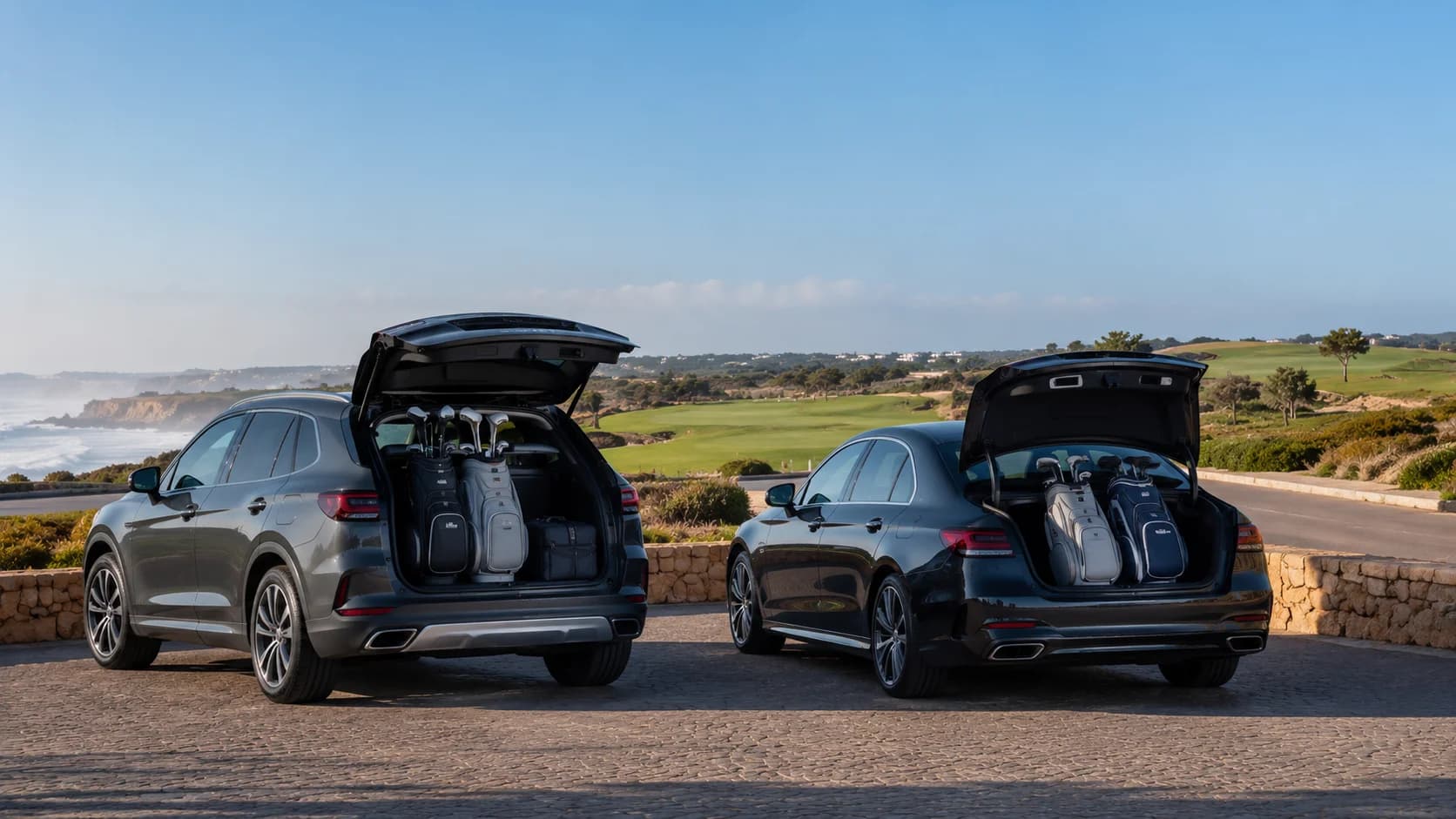
For travelers renting a car in Essaouira, this route also demonstrates why vehicle choice matters. A sedan is efficient for two to four travelers, an SUV offers additional luggage space and comfort, while a 7-seater can make a major difference for families or larger groups.
Table of Contents
- Essaouira to Rabat
- Distance and travel time
- Best route north
- Where to break the journey
- Turning a long transfer into a road trip
- Safi, El Jadida and Casablanca corridor options
- Fuel and road-cost planning
- Arriving and parking in Rabat
- Passenger comfort over longer distances
- Family and luggage considerations
- Best vehicle for a long drive
- Sedan, SUV and 7-seater scenarios
- Rabat arrival timing
- Multi-city rental planning
- Road-trip checklist
- FAQs
Essaouira to Rabat
The best practical route from Essaouira to Rabat is generally north toward Safi, followed by the motorway corridor through El Jadida and Casablanca before continuing to Rabat.
Plan on roughly 435 km and about 5 to 6 hours of driving, before longer stops.
A useful route is:
Essaouira → N1 toward Safi → Safi Nord motorway access → El Jadida → Casablanca → Rabat
Morocco’s motorway network includes the El Jadida–Safi section, which is approximately 143 km long, followed by the motorway connections toward Casablanca and Rabat.
For a relaxed journey, leave Essaouira in the morning, choose one main stop, and aim to arrive in Rabat before the busiest evening traffic.
Distance and Travel Time
The Essaouira to Rabat distance by road is about 435 km for a typical direct routing. Route planners estimate a nonstop drive at approximately 5 hours 10 minutes, although actual times depend on traffic, roadworks, stops and your exact departure and arrival addresses.
For trip planning, it is better to think in terms of three sections rather than one continuous drive:
Essaouira to Safi: the slower regional-road section.
Safi to the Casablanca area: mostly faster motorway driving after joining the motorway north of Safi.
Casablanca to Rabat: a major motorway corridor where traffic can affect arrival time.
If you add sightseeing in Safi, Oualidia or El Jadida, the journey can easily become a full-day Atlantic road trip.
Best Route North
For most travelers, the best route combines the N1 north of Essaouira with Morocco’s motorway system.
Leave Essaouira heading north toward Safi. The N1 continues along Morocco’s Atlantic side and connects the Essaouira and Safi areas. The national-road section requires more attention than motorway driving because speeds vary and you may encounter local traffic, junctions and settlements.
Near Safi, join the motorway northbound where appropriate. Morocco’s Autoroutes du Maroc confirms that the El Jadida–Safi motorway section extends approximately 143 km and includes interchanges serving Safi Nord, Oualidia, Sidi Smail, Jorf Lasfar and El Jadida.
Continue toward El Jadida and Casablanca, then follow the motorway toward Rabat.
For travelers whose priority is reaching Rabat efficiently, remaining on the motorway once you reach it is normally preferable to making repeated coastal detours.
Where to Break the Journey
A break is worthwhile on a journey of this length even if you are not sightseeing.
Safi
Safi is the first major city north of Essaouira and therefore a logical early stop. It works particularly well if you leave Essaouira without breakfast or want to take a break before joining the faster motorway section.
Stopping here divides the trip naturally into a regional-road section followed by longer motorway driving.
Oualidia
Oualidia is suitable when the journey itself is part of your holiday rather than simply a transfer.
The motorway has an interchange serving the Oualidia area, making it possible to leave the main route and reconnect afterward.
Allow extra time because reaching the lagoon and returning to the motorway makes this more than a quick service-station stop.
El Jadida
El Jadida is one of the best choices for travelers who want one substantial break roughly between Essaouira and Rabat.
It can work for lunch, a short walk or simply a longer rest before continuing through the more heavily traveled Casablanca corridor.
Casablanca
Casablanca is best treated as an optional stop rather than a necessary one. Entering central Casablanca can add considerable urban driving to a day that is already long.
If Rabat is your priority, follow the motorway signs around the Casablanca corridor rather than driving into the center unless Casablanca is specifically part of your itinerary.
Turning a Long Transfer Into a Road Trip
One advantage of traveling Essaouira to Rabat by car is flexibility.
A direct transfer focuses on covering the distance as efficiently as possible. A self-drive road trip lets you turn the same geographic corridor into several different itineraries.
A fast version might include only a coffee or fuel stop near Safi.
A moderate itinerary could combine Essaouira, lunch around El Jadida and an afternoon arrival in Rabat.
A full road-trip day could include Safi or Oualidia plus El Jadida, followed by an evening arrival in Rabat.
Avoid trying to visit every possible stop in a single day. Safi, Oualidia, El Jadida and Casablanca can each consume significantly more time once parking, walking and meals are included.
Safi, El Jadida and Casablanca Corridor Options
Your stopping strategy should depend on what you want from the trip.
Choose Safi if you want the earliest major break.
Choose Oualidia if a coastal detour and slower travel day matter more than arrival time.
Choose El Jadida if you want one convenient major stop before the Casablanca section.
Choose Casablanca only if the city itself is part of your itinerary.
This flexibility is one reason a rental car works particularly well for multi-city Morocco travel. You are not tied to fixed departure times and can adjust the day according to weather, traffic and passenger comfort.
Fuel and Road-Cost Planning
Start the trip with sufficient fuel rather than waiting until the tank is low.
Essaouira and Safi provide opportunities to refuel, and service areas are also available on the motorway network. Autoroutes du Maroc lists motorway service areas on the Safi–Casablanca and Casablanca–Rabat corridors, including facilities around Bir Jdid and Bouznika.
You should also budget for motorway tolls.
The current ADM tariff grid lists Casablanca–Safi Nord at 76 MAD for a Class 1 vehicle and Casablanca–Rabat at 25 MAD for Class 1. Toll classification can differ according to vehicle dimensions, so larger vehicles should not assume the same rate as a standard passenger car.
ADM also operates Jawaz electronic toll payment, although rental-car arrangements vary, so check whether the vehicle has a compatible pass before relying on it.
Keep some Moroccan dirhams available for road expenses and check current motorway traffic before departure.
Arriving and Parking in Rabat
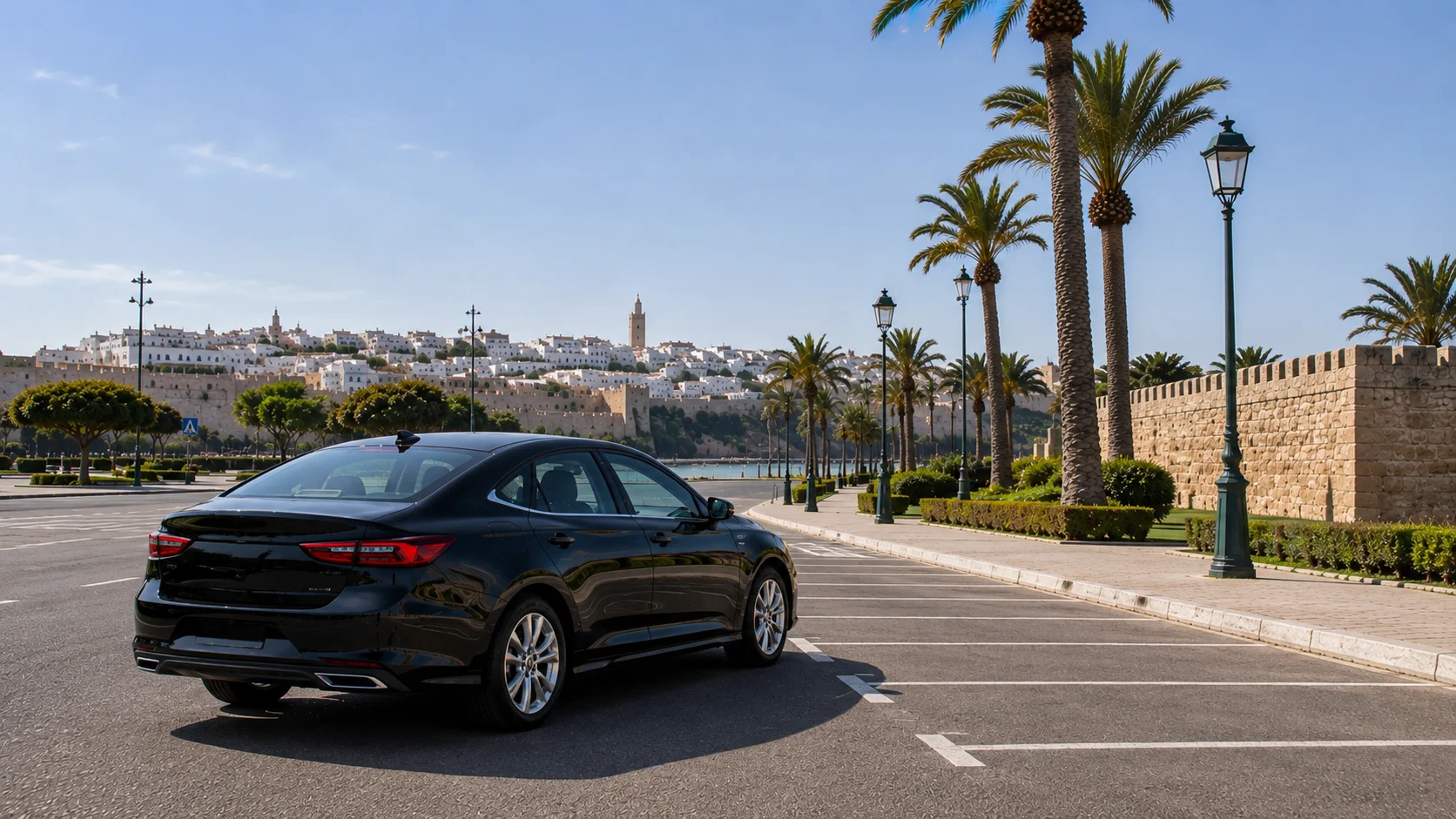
Rabat is much larger and busier than Essaouira, so the final part of the journey deserves some planning.
Set your exact hotel, apartment or parking location before reaching the metropolitan area instead of waiting until you are already in city traffic.
Rabat has an organized paid-parking system. Rabat Parking, the city parking operator, reports thousands of managed on-street spaces as well as surface and structured parking facilities.
If your accommodation offers private parking, confirm the entrance instructions in advance. This can be especially useful in central districts where finding an unfamiliar parking entrance after a five-hour drive is unnecessarily stressful.
Do not assume that a riad or central accommodation has vehicle access directly outside its door.
Passenger Comfort Over Longer Distances
Vehicle comfort matters much more over 435 km than it does for short drives around Essaouira.
Before choosing the cheapest vehicle available, consider:
-
seat comfort for several continuous hours
-
air-conditioning
-
rear-seat legroom
-
luggage capacity
-
number of passengers
-
ease of motorway overtaking and cruising
-
child-seat requirements
-
whether every passenger can sit comfortably without luggage inside the cabin
Taking a short break every couple of hours can also make the second half of the trip considerably easier.
Family and Luggage Considerations
Families should choose a vehicle according to passengers plus luggage, not seat count alone.
A car advertised for five occupants may technically seat five people, but five travelers with several large suitcases can quickly exceed practical boot space.
The same applies to seven-seat vehicles. When every seat is occupied, luggage capacity behind the final row can be smaller than travelers expect.
If you are traveling with children, strollers or several suitcases, confirm the usable luggage space before booking.
Best Vehicle for a Long Drive
There is no single vehicle type that every traveler needs.
Sedan Rental for Couples and Small Families
A sedan rental in Essaouira is usually the most balanced choice for two to four passengers.
Sedans are suitable for this trip because the route is mainly paved road and motorway. They also typically provide a separate luggage compartment and comfortable motorway driving without the size of a larger SUV.
SUV Rental for Space and Comfort
An SUV rental in Essaouira can make sense when passengers have more luggage, want easier entry and exit, or simply prefer additional cabin space.
An SUV is not required because of road conditions on the standard Essaouira–Rabat route. Its main advantages here are comfort, seating position and luggage practicality.
7-Seater Rental for Larger Groups
A 7 seater car rental in Essaouira is useful for families or groups that would otherwise need two smaller vehicles.
It is particularly practical when the journey forms part of a longer Morocco itinerary involving several cities.
Always check luggage capacity when using all seven seats.
Sedan, SUV and 7-Seater Scenarios
Two adults with two suitcases: a sedan is generally sufficient.
Couple with several large bags: sedan or SUV depending on luggage volume.
Family of four with children and stroller: a roomy sedan or SUV is often more comfortable.
Five adults with luggage: an SUV or larger people carrier deserves consideration.
Six or seven passengers: choose a genuine 7-seater and confirm luggage arrangements in advance.
The best vehicle is the one that leaves enough usable space after everyone and everything is inside.
Rabat Arrival Timing
Morning departure from Essaouira is the easiest strategy.
Leaving around breakfast time gives you flexibility for traffic and one substantial stop while still providing a good chance of reaching Rabat during daylight.
A very late departure can put you into Rabat after dark after several hours of driving. It can also increase the chance of reaching the Casablanca–Rabat corridor during a busy period.
Check live traffic on the day of travel, particularly around Casablanca and Rabat. Autoroutes du Maroc provides real-time motorway traffic information for journey planning.
Multi-City Rental Planning
The route works particularly well as one stage of a larger Morocco itinerary.
For example:
Marrakech → Essaouira → El Jadida → Rabat → Tangier
or
Agadir → Essaouira → Rabat → Fes
If you intend to finish your rental in Rabat rather than returning the car to Essaouira, confirm the one-way arrangement before booking. Different-city drop-off conditions and fees can depend on the rental company, vehicle and availability.
Also confirm the rental agreement permits your complete itinerary before beginning a multi-city trip.
Road-Trip Checklist
-
Confirm the rental agreement covers your full itinerary.
-
Check whether Rabat drop-off is permitted if you are planning a one-way rental.
-
Start with enough fuel.
-
Save your Rabat accommodation and parking location before departure.
-
Carry your driving licence, passport and rental documents.
-
Keep Moroccan dirhams available for tolls and incidental road costs.
-
Confirm the luggage fits before leaving Essaouira.
-
Check child seats if traveling with young children.
-
Check current motorway traffic and road conditions.
-
Plan at least one rest stop.
-
Allow additional time if visiting Safi, Oualidia or El Jadida.
-
Avoid scheduling an important Rabat appointment immediately after your estimated arrival time.
Frequently Asked Questions
How far is Rabat from Essaouira by car?
The normal road distance is approximately 435 km, although the exact figure varies according to your starting point, destination and route.
How many hours is the drive?
A direct drive takes roughly 5 hours 10 minutes in favorable conditions. Allow closer to six hours or more once you include traffic, fuel and rest stops.
Can I drive Essaouira to Rabat in one day?
Yes. It is a realistic one-day drive. Leaving in the morning makes the journey more comfortable and gives you time for a proper break.
What is the best route to Rabat?
A practical route is to travel north from Essaouira toward Safi, join the motorway near Safi and continue via the El Jadida and Casablanca corridor before taking the motorway toward Rabat. ADM confirms the El Jadida–Safi motorway as part of this northbound corridor.
Where should I stop on the way?
Safi is convenient for an early break. Oualidia suits travelers who want a coastal detour, while El Jadida is a good choice for a longer midway stop.
Do I need an SUV?
No. The normal route is suitable for a standard passenger car. An SUV is mainly useful for additional passenger comfort, luggage room and a higher seating position.
Is a 7-seater useful for families on this route?
Yes, particularly for larger families, but check luggage capacity carefully if all seven seats will be occupied.
Are there tolls near Casablanca or Rabat?
Yes. Much of the motorway section north of Safi is tolled. Current ADM tariffs list Safi Nord–Casablanca and Casablanca–Rabat charges, with rates depending on vehicle class.
Can I rent a car in Essaouira for a Rabat road trip?
Yes, provided the rental agreement permits the itinerary. If you intend to leave the vehicle in Rabat rather than return it to Essaouira, arrange the one-way drop-off in advance.
What time should I leave Essaouira?
A morning departure is best for most travelers. It gives you more daylight, flexibility for stops and a better buffer for traffic approaching Casablanca and Rabat.
Build a Comfortable Essaouira to Rabat Road Trip
Driving Essaouira to Rabat by car transforms a long transfer into a flexible Atlantic Morocco road trip. The approximately 435 km journey can be completed in one day, while Safi, Oualidia, El Jadida and Casablanca provide opportunities to turn the route into a broader itinerary.
For two to four travelers, a sedan rental in Essaouira offers an efficient long-distance option. Travelers wanting more passenger or luggage space can consider an SUV rental in Essaouira, while larger families and groups can explore 7 seater car rental in Essaouira.
MarHire Car Essaouira offers sedans, SUVs and 7-seat vehicles suited to longer Morocco drives, giving travelers the flexibility to build a comfortable multi-city itinerary from the Atlantic coast to Rabat and beyond.