







Car rental insurance Essaouira terms can appear complicated when different companies use phrases such as full insurance, CDW, theft protection, excess and zero excess. Some travelers believe “fully insured” means they can never be charged for damage, while others arrive expecting a large credit card deposit even when they selected additional coverage.
The reality is that rental insurance becomes much easier to understand once you separate three things: what damage is covered, how much financial responsibility remains with the renter and whether the company requires a security deposit.
Car rentals in Essaouira normally include a basic level of insurance, but the exact protection depends on the rental agreement. Collision Damage Waiver can limit your liability for damage to the rental vehicle, while theft protection may cover the vehicle if it is stolen. However, both can still include an excess.
Full insurance may provide broader protection or reduce the excess, but it does not automatically cover every situation. Glass, tyres, the vehicle interior, lost keys, incorrect fuel and negligent driving may remain excluded.
Always request the exact excess, deposit amount and list of exclusions in writing before confirming your booking.
Why Rental Insurance Confuses Travelers
Rental insurance is confusing because companies do not always use the same terminology. One business may advertise “full insurance” while another describes a similar package as Super CDW, premium protection or reduced-excess cover.
The phrase “full insurance” is especially important to question. It may mean:
-
Collision damage protection with an excess
-
Collision and theft protection
-
A lower excess rather than zero excess
-
Additional glass or tyre protection
-
A package that excludes several types of damage
This does not necessarily mean the company is being dishonest. Rental companies work with different insurers, vehicle groups and contract conditions. However, the customer should receive a clear explanation before paying.
Do not judge a rental package by its name alone. Ask for the exact financial responsibility that applies if the vehicle is damaged or stolen.
What Full Insurance Covers
Full insurance car rental Morocco packages generally aim to reduce the renter’s financial exposure. Depending on the agreement, protection may include accidental body damage, collision damage, theft and third-party liability.
Moroccan automobile insurance can include different guarantees for collision, damage to the insured vehicle and assistance. The exact protection depends on the insurance contract rather than a universal definition of “full cover.”
A typical rental protection package may cover:
-
Damage to exterior body panels following a covered collision
-
Damage caused by another identified vehicle
-
Theft of the rental vehicle
-
Third-party damage, subject to the policy
-
Roadside assistance after a covered incident
Even broad protection normally requires the renter to respect the rental agreement. The driver must be authorised, hold a valid licence and use the vehicle only in permitted areas.
Insurance can also become invalid when damage results from prohibited or negligent behaviour. Examples can include driving under the influence, allowing an unauthorised person to drive, taking the vehicle off road without permission or failing to report an accident correctly.
Before booking a car rental Essaouira, request a written summary showing what is included in the advertised price.
CDW and Theft Protection
CDW means Collision Damage Waiver. Despite the name, it does not always eliminate your responsibility for damage.
Its main purpose is to limit how much you may have to pay when the rental vehicle is damaged in a covered collision. Without an applicable damage waiver, a renter could potentially be responsible for a much larger repair cost, depending on the contract.
With CDW, the renter’s responsibility is usually limited to an agreed excess. For example, when a contract has an excess of 7,000 MAD, the renter may remain liable for covered damage up to that amount. This is only an example. The real figure must appear in your booking conditions.
Super CDW or an upgraded protection package may reduce that excess further. Some packages bring it close to zero, but exclusions can still remain. Major rental terms in Morocco show that upgraded protection may reduce the excess without necessarily covering every possible type of loss.
Theft protection works in a similar way. It can limit your responsibility if the entire rental vehicle is stolen, but it may have its own excess and reporting requirements.
Theft protection may not cover:
-
Personal belongings left inside the vehicle
-
Theft caused by leaving the keys in the car
-
Lost or stolen rental keys
-
Failure to file a police report
-
Failure to return the vehicle documents
-
An incident involving serious negligence
Ask whether collision and theft have the same excess. Some contracts use separate amounts.
What “Excess” Actually Means
The excess, also called the deductible or franchise, is the maximum amount the renter may have to contribute toward a covered claim.
Suppose the rental agreement has a 5,000 MAD excess:
-
If covered repairs cost 2,000 MAD, the renter may pay up to 2,000 MAD.
-
If covered repairs cost 12,000 MAD, the renter may pay up to the 5,000 MAD excess.
-
The insurance arrangement may handle the remaining eligible amount.
This simplified example assumes that the incident is covered and that the renter followed every contract requirement.
An excess is not an automatic charge. It is a limit on potential responsibility for eligible damage. However, the company may temporarily block a deposit linked to that amount when the vehicle is collected.
No-excess car rental Essaouira generally means the renter’s excess for specified covered damage has been reduced to zero. It does not mean that all damage, fines, cleaning costs or contract violations are covered.
You should still inspect the exclusions and claim procedure.
Glass Cover and Exclusions
Glass is one of the most commonly misunderstood areas of rental insurance.
A basic CDW package may cover exterior body damage but exclude the windscreen, windows, mirrors, lights or panoramic roof. An upgraded package may include some of these components, but this should be stated clearly.
Common exclusions can include:
-
Windscreen and window damage
-
Tyres, wheels and wheel covers
-
Undercarriage damage
-
Roof damage
-
Interior stains, burns or broken fittings
-
Lost keys or damaged key systems
-
Incorrect fuel
-
Mechanical damage caused by misuse
-
Driving on prohibited roads
-
Damage caused by an unauthorised driver
-
Personal belongings inside the car
-
Traffic fines and parking penalties
Water and sand damage may also be excluded. This matters around Essaouira because drivers may be tempted to take a rental vehicle onto beaches, rough coastal tracks or unpaved access roads.
Unless the rental company gives written permission, keep the vehicle on normal public roads. An SUV does not automatically include permission for off-road driving.
When booking a sedan rental Essaouira, check whether tyres, glass and roadside assistance are included or available separately.
How Deposits Relate to Insurance
Insurance excess and security deposits are connected, but they are not the same thing.
The excess is the amount of financial responsibility that may remain after a covered incident. The deposit is money or a card authorisation held as security during the rental.
Some rental companies set the deposit at approximately the same level as the excess. Others use a different amount based on the vehicle category, insurance package, rental duration or payment method. Published rental conditions in Morocco show that some companies directly link the deposit authorisation to the applicable deductible.
A deposit may also be used to cover costs that insurance does not address, such as:
-
Missing fuel
-
Late return charges
-
Traffic fines
-
Lost keys
-
Excessive cleaning
-
Missing equipment
-
Unauthorised extensions
Full insurance does not always remove the deposit. Conversely, a no-deposit rental does not necessarily mean zero excess.
With no deposit car rental Essaouira, eligible standard vehicles can be collected without the large security block often required at traditional rental desks. The insurance excess and exclusions should still be confirmed in the agreement.
The Hard Sell to Watch for Elsewhere
Some travelers reserve an inexpensive vehicle online and later discover that the displayed price includes only basic protection with a substantial excess. At collection, they may be offered additional products that significantly increase the final cost.
Common pressure tactics can include:
-
Claiming that the booked protection provides almost no value
-
Presenting optional upgrades as mandatory
-
Refusing the car unless the customer buys another package
-
Using unclear explanations about card coverage
-
Discussing the excess only after the customer arrives
-
Asking for a much larger deposit than expected
-
Adding protection without clearly confirming the price
Not every desk follows these practices, but renters should know how to protect themselves.
Request the following before travelling:
-
The complete rental price
-
The insurance package included
-
The collision excess
-
The theft excess
-
The security deposit
-
The exclusions
-
The cost of any optional upgrades
Never sign a document you do not understand. Ask the representative to explain every new charge and request an updated total before accepting it.
What to Check Before You Book
A good rental company should be able to answer direct insurance questions without vague wording.
Ask these questions before confirming:
What insurance is included?
Request the complete name of the protection package and a simple explanation of what it covers.
What is the excess?
Ask for an exact amount in Moroccan dirhams. Do not accept answers such as “small excess” or “standard excess.”
Is theft protection included?
Confirm whether theft has a separate deductible and whether the keys and vehicle documents must be returned.
Are glass and tyres covered?
Do not assume that “full insurance” includes them.
Is a deposit required?
Ask how much will be blocked, which payment methods are accepted and when the authorisation will be released.
Are there road restrictions?
Confirm whether the vehicle can be driven on mountain roads, rural roads or unpaved tracks.
Who is authorised to drive?
Every driver should be listed in the contract. Insurance may not apply when an unregistered person is behind the wheel.
What evidence is required after an incident?
Ask whether you need a police report, accident statement, photographs or another official document.
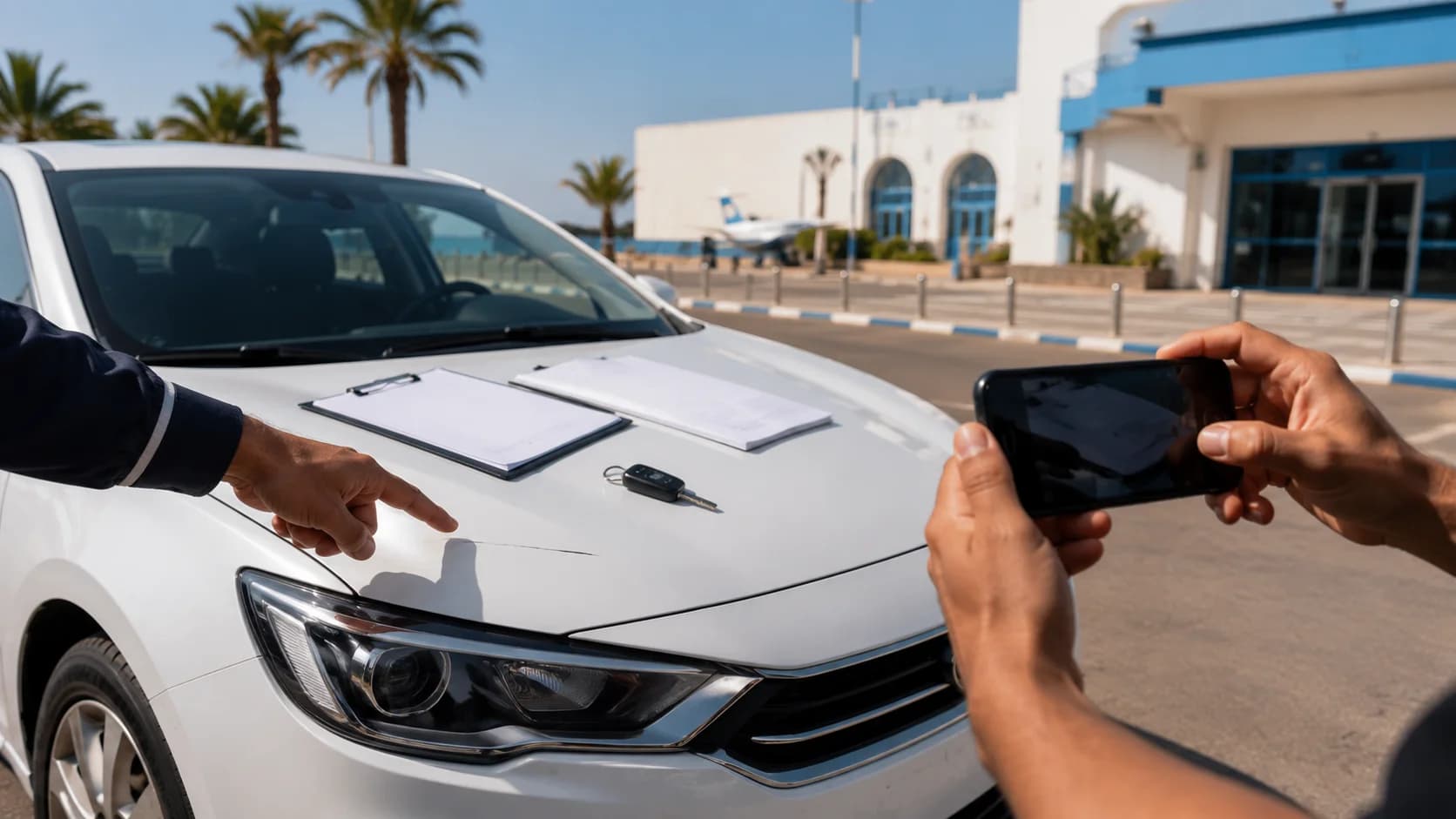
It is also sensible to photograph the car during collection. Record every visible scratch, wheel mark, windscreen chip and interior issue. Repeat the process when returning the vehicle.
Making a Claim on the Road
After an accident, prioritize safety. Stop in a safe place where possible, use the vehicle’s warning equipment and contact emergency services if anyone is injured.
Then contact the rental company immediately. Do not arrange repairs, towing or payment to another driver without authorisation unless an emergency requires immediate action.
For an accident involving material damage, Morocco’s insurance regulator advises drivers to remain at the scene and complete an accident statement with the other driver. When the other party refuses, the authorities should be contacted.
Your rental company may ask you to:
-
Photograph the vehicles and surroundings
-
Record the other vehicle’s registration and insurance details
-
Complete the constat amiable accident form
-
Contact the police or gendarmerie when required
-
Keep the vehicle keys and documents secure
-
Send all documents to the rental company promptly
Do not admit responsibility or sign an unclear statement simply to resolve the situation quickly.
Moroccan insurance guidance states that an accident declaration should generally be provided to the insurer within five days. Rental customers should notify the rental company immediately because the company manages the policy and may impose a shorter operational reporting deadline in its rental conditions.
In case of theft, contact both the police and the rental company immediately. Obtain a copy of the official report and follow the company’s instructions.
Drive Fully Covered
The best insurance package is not necessarily the one with the longest name. It is the one that clearly tells you what is covered, what remains excluded and exactly how much you could pay after an incident.
Before renting in Essaouira, remember these points:
-
CDW usually limits responsibility rather than removing it.
-
Theft protection may have a separate excess.
-
Full insurance does not guarantee that glass, tyres or keys are covered.
-
Zero excess still has contract exclusions.
-
A deposit and an insurance excess are different.
-
Every authorised driver must appear in the rental agreement.
-
Accidents and theft must be reported immediately.
No counter hard sell and no nasty surprises. Every MarHire Car Essaouira rental includes full insurance with a clearly stated excess, while eligible standard cars are available without a security deposit.
Confirm your dates, vehicle and insurance conditions before arrival so you can collect the keys and explore Essaouira with confidence.
Frequently Asked Questions
Is insurance included with car rental in Essaouira?
Most legitimate rentals include at least basic insurance, but the protection level, excess and exclusions vary. Request the complete conditions before booking.
What does full insurance cover in Morocco?
Full insurance may cover collision damage, theft and third-party liability, but there is no universal package. Glass, tyres, keys, the interior and negligent use may remain excluded.
What is the excess on a rental car?
The excess is the maximum amount you may have to contribute toward an eligible insurance claim. The exact amount should be written in your rental agreement.
Is glass covered on an Essaouira rental?
Not always. Windscreens, windows, mirrors and lights are frequently excluded from basic CDW unless additional glass protection is included.
Is theft covered by rental insurance?
It may be included through theft protection. Coverage normally requires an official police report, immediate notification and the return of the keys and vehicle documents.
Do you still pay a deposit with full insurance?
Possibly. Some companies continue to require a deposit even with upgraded insurance. Ask separately about the excess and deposit.
What is no-excess car rental?
No-excess rental means the excess for specified covered claims has been reduced to zero. Exclusions and additional charges can still apply.
Should you buy excess insurance in advance?
It depends on the included rental protection and any separate travel or card coverage. Check whether outside insurance reimburses you after payment or deals directly with the rental company.
What should you do after an accident?
Stop safely, contact the rental company, document the scene, exchange information and complete the required accident report. Contact the authorities when necessary.
What is excluded from rental insurance?
Common exclusions include tyres, glass, the undercarriage, interior damage, lost keys, incorrect fuel, unauthorised drivers, prohibited roads, fines and damage caused by negligence.